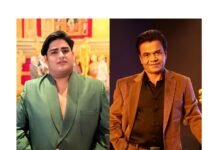

Ajinkya Jadhav’s Paparazzi Entertainment is not just bridging the gap between human creativity and AI through their videos but also starting a unique conversation around spirituality and religion with their podcast, The Vedas Speak. It is hosted by Dr. Sammeer Arora, and the recent guest on the show was Kahiin To Hoga, Kaahin Kissii Roz, Sapna Babul Ka…Bidaai, Sasural Simar Ka, Ek Shringaar- Swabhiman, Nima Denzongpa, and Katha Ankahee actor Manish Raisinghani. The actor spoke about his Sindhi origin and shared that his family has always been very open and accepting.
He said, “In our families, we have never heard anyone say that no one from outside the community should come or that you must only marry within Sindhis. We very rarely hear such things. Plus, our culture—whatever we have—I have seen it’s such a mixed bag. We have adapted the best from all possible sides. It’s amazing how, even in food, we have such variety: we have kokis, kadhi chawal, everything. But you’ll also see every kind of food; my community is very passionate. They know how to earn, how to spend, and how to give back in service.”
“Touch wood, I don’t know how much I have contributed to society or to my community, but it has always been amazing. We know how to live life fully,” he added.
While talking about Sindhis, he also gave an insight into Cheti Chand, the birth anniversary of Lord Jhulelal. He said, “The Hindu calendar aligns such that everyone’s New Years often fall around the same time. Gudi Padwa happens around the same time in Maharashtra. All these festivals coincided and blended together. Even Ugadi, the festival celebrated in Andhra and Hyderabad, coincides with Cheti Chand. So, in a way, the birthday of Lord Jhulelal Sai is celebrated in different forms across almost all of India.”
He further shared that as a kid he would watch the procession during Cheti Chand. He said, “But these jhankiyas weren’t just about Jhulelal Sai; they celebrate all gods. You have these elaborately decorated chariots, and on them, there are live displays—Lord Rama sitting, Vishnu ji seated on Sheshnag, Lakshmi ji doing her part, and so on. All these things are beautifully represented.”
Though he shared that his parents visit temples a lot, he doesn’t go very often. He said, “The Jhulelal Sai temple in Ajmer is the largest, and the statue of Jhulelal Sai there is enormous—I believe it’s about 20 or 30 feet tall. Earlier, we used to go there once a year, but now we don’t get the chance. But, yeah, I think it’s more inward—God is right here. You may go to a temple and still not feel connected, but sometimes sitting quietly, you can feel Him right here. That’s how we experience it.”
“And I think that’s the way most Sindhis practice devotion. There aren’t many Jhulelal Sai temples, but almost every household has an idol, and everyone follows the basic ritual of maintaining an altar at home. It’s very insightful and teaches practical ways to deal with different kinds of life problems. I’ve had conversations with Maneer, and the approach is very interesting. Spirituality—even martial arts—is a form of spirituality,” he ended.